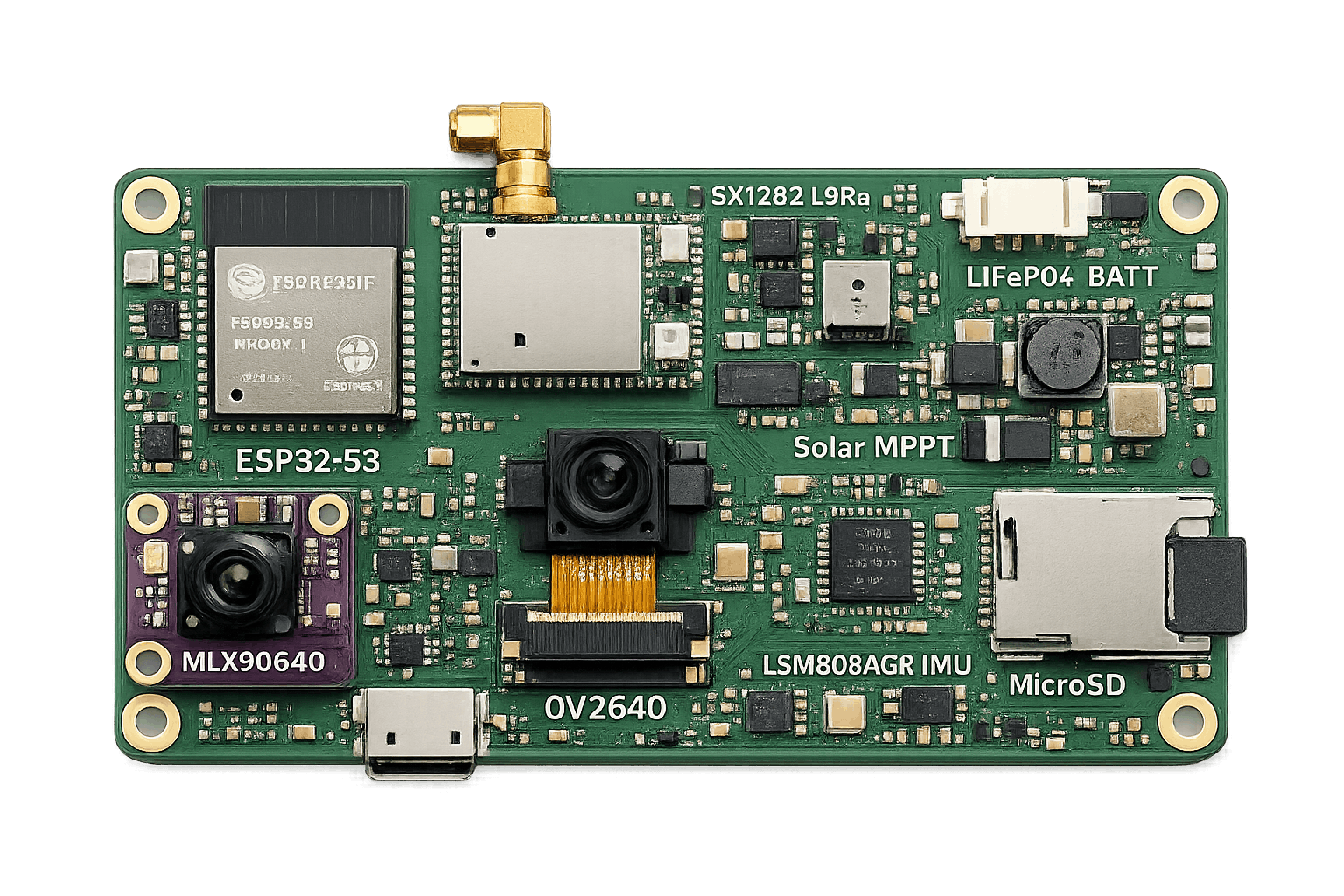
Early Warning Alert System for National Border Security
A distributed network of autonomous, solar-powered detection probes with AI-driven classification, LoRa mesh networking, and precision triangulation for the Lithuanian national border.
Explore the SystemAutonomous detection where traditional surveillance fails
Lithuania's extensive forested border presents unique surveillance challenges: dense vegetation blocks line-of-sight, wildlife triggers cause high false alarm rates, extreme seasonal temperatures strain equipment, and traditional infrastructure is costly to deploy and maintain in remote areas.
A mesh of small, autonomous "border probes" deployed at strategic intervals along the border. Each probe combines solar power for year-round energy autonomy, thermal + visual AI detection for intelligent threat classification, compass-based directional awareness for precision triangulation, and LoRa mesh networking for reliable long-range communication without cellular infrastructure.
The two-stage AI pipeline filters 70-90% of wildlife false alarms before alerting operators, dramatically reducing operator fatigue while maintaining detection reliability.

Power-efficient AI classification that sleeps until it matters
Deep sleep mode
~150 µA / 0.5 mW
MLX90640 detects
heat signature
Lightweight classifier
~50 ms / 0.001 Wh
OV2640 + TFLite Micro
~1–2 min / 0.05–0.10 Wh
LoRa mesh alert +
detection ray + image
Purpose-selected components for autonomous border monitoring
$30–40
Main compute & communication board with integrated LoRa radio and GPS.
$40–60
Far-infrared thermal array for day/night human detection at 15–30 m range.
~$4
Compass heading for detection ray orientation and tamper detection via accelerometer.
$5–15
Visual camera for Stage 2 AI classification, downsampled for edge inference.
$20–35
Primary power source with optimized tilt angle for Lithuanian latitude.
$40–70
High-capacity battery for multi-day autonomy during winter low-solar periods.
$5–15
External antenna for extended LoRa mesh range through forest canopy.
$15–40
Sealed ABS housing with cable glands, rated for -40°C to +60°C.
$10–15
Local evidence storage for captured images and event logs.
$5–10
Maximum power point tracking for optimal solar energy harvesting.
Power budget, solar production, and sensor capabilities
| Mode | Current | Energy |
|---|---|---|
| Sleep (99%+ time) | ~150 µA | 0.5 mW |
| Stage 1: Thermal triage | 50 mA, 100 ms | 0.001 Wh |
| Stage 2: Full analysis | 200–300 mA, 1–2 min | 0.05–0.10 Wh |
10W panel, Lithuania latitude, with forest canopy factor
| Thermal resolution | 32 × 24 pixels |
| Thermal FOV | 55° |
| Angular accuracy | ~0.86° (sub-pixel) |
| Detection range | 15–30 m (human) |
| Camera resolution | 2 MP (OV2640) |
| AI inference input | 96 × 96 px |
| LoRa frequency | 868 MHz (EU) |
| LoRa spreading | SF10 |
| GPS accuracy | ~2.5 m (averaged) |
| Compass heading | ±2° (calibrated) |
Resilient communication without cellular infrastructure
Preferred mode. Probes send alerts straight to the nearest border post receiver for lowest latency.
When direct range is limited, alerts hop through neighboring probes using Meshtastic mesh protocol.
Heartbeat every 15–30 min reports battery, solar rate, GPS quality, heading, temperature, and event count.
Pinpointing intrusions with sub-degree angular precision
Each probe knows its exact position and the direction it faces, establishing a geographic reference frame.
The MLX90640 determines the angular position of a heat source within its 55° FOV to ~0.86° accuracy via sub-pixel centroid fitting.
Combining GPS position + compass heading + thermal bearing produces a "detection ray" — a precise direction line in absolute geographic coordinates.
Two or more probes observing the same target produce intersecting rays, pinpointing the target's location to an ~80–100 m² zone. More probes = higher confidence.
Sub-Project 6 consortium within the national R&D programme
Design for Safety & Security
Regulatory & Safety-Cybersecurity Compliance
Sensor Hardware Technology Development
Software Technology Development
Consortium Partner
Designed for full EU regulatory alignment
Non-intrusive surveillance approach. No facial recognition. Thermal-only classification preserves individual privacy while detecting threats.
Transparent classification pipeline. All AI decisions logged with confidence scores. Human-in-the-loop for critical alerts.
Images stored locally on encrypted MicroSD only. No video streaming. Data retained per strict retention policy. Privacy by design.
AES-256 encrypted LoRa communications. Secure boot on ESP32-S3. Tamper detection with accelerometer alerts.
36-month project milestones and measurable outcomes